Reading the Room: A Field Guide to Tables, Benches and Borrowed Conversation at Calver's
Every pub has a floor plan. Calver's has a constitution — unwritten, mildly enforced, and understood by roughly everyone who has walked through the door more than four times.
None of it is printed anywhere. It lives in the way a stranger's hand hovers over the back of a chair, the way a regular lifts their chin at the door, the way the long bench under the chalkboard fills up from the far end inwards and never the other way round. Learn to read it and you will never do that awkward hover by the door again, pint in hand, pretending to check your phone. Ignore it and you will still get served, still get a seat — but you will notice a polite coolness you cannot quite put your finger on.
So here it is, written down for the first time, which will probably annoy the people who rely on it staying unwritten.
The corner table is a commons, not a reservation
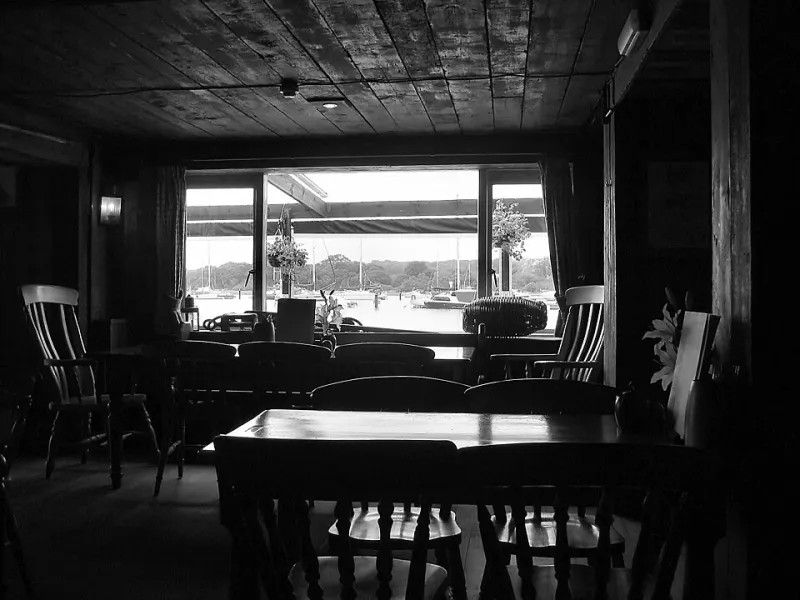
The table in the window, the one with the short leg and the beer mat folded under it, seats four at a push and is the best seat in the building: you can watch the street, you can watch the bar, and you get the last of the evening light. It is also the most misunderstood piece of furniture we own.
The rule is simple enough. One person, one pint, one paperback or one crossword — take the table, by all means, but leave the rest of it visibly free. Bag on the floor, not on the chair. If you spread out like you are marking your territory, you have effectively booked the table in everyone else's mind, and nobody will ask to join you, and you will feel oddly lonely in the best seat in the house.
A coat draped over a chair back is a claim, and a claim is good until roughly nine o'clock. After nine, on a Friday, the claim expires. The coat goes on the back of your own chair, the newcomers get the other side of the table, and within ten minutes you are all arguing about the football. That is not an accident. That is the whole point.
The bench under the chalkboard
The long bench along the wall, under the blackboard with the guest ale and the pie of the week, is shared by default after seven. Not asked about, not negotiated — shared. The etiquette is to start at the far end, nearest the fire, and work inwards as the evening fills up. Leaving a conspicuous gap in the middle so your group can arrive later is a capital offence in this building, and we will all be very nice to you about it while quietly judging.
If you want to join a bench that already has people on it, you do not need a speech. Tilt your glass towards the free space, raise your eyebrows, wait half a second. A small nod back means yes. A flat stare and a pointed shift of a bag means not yet. Nobody is being rude. It is just a very efficient system.
Reading a regular, without staring
Regulars broadcast their availability with the sort of subtlety usually reserved for birdwatching.
Coat on chair, body angled towards the room, phone face-down on the table: open. Sit down, say hello, you will be talking about the bus route within four minutes.
Shoulders squared to the wall, newspaper folded to a single column, one earphone in: closed, but politely so. They will look up if you speak. They would rather you did not. Respect it and they will remember you as a person with excellent instincts.
The dog under the table with its lead looped round a chair leg is a half-open door. The dog is not an invitation, but it is not a wall either. Ask before you fuss. Always ask before you fuss.
The standing crowd do not want your seat
There is a knot of people who stand along the brass rail at the end of the bar every Thursday and Friday, and every week somebody tries to give them a chair. Stop. They are not waiting. They are not uncomfortable. They have chosen the rail because it is near the hatch, near the conversation, and near the door for a cigarette at half past ten. Offering a seat once is friendly. Offering it three times is nagging.
Saying hello, briefly
The grammar of a neighbourhood bar is short. Chin lift at the door. 'All right?' as you pass, not as a question, more as a weather report. First names only after the second meeting. No handshakes unless somebody has been away.
If you are new and you want to meet people, the bar is your introduction service. Ask whoever is pulling pints who the dog belongs to, or what the pie is, or whether the quiz is on Tuesday — and they will point you at the right table. That is not staff going above and beyond. That is the job.
The small rules that keep a local feeling local
Buy your round when it is your round, and if you are unsure whether it is your round, it is your round.
Do not occupy the quiz table on a Tuesday after half seven unless you are playing. The quiz is four rounds, it is not serious, and the winning team buys the losing team a bag of crisps.
Move your chair back where you found it. Not because anyone will tell you off, but because the next person in will be a 78-year-old who likes the aisle clear.
And when you leave, say goodnight. Not to everyone — to the room, generally, with a small wave. It is the cheapest thing you will do all evening and it is worth more than the tip.