Who Gets the Aux? How Calver's Actually Builds a Night's Soundtrack

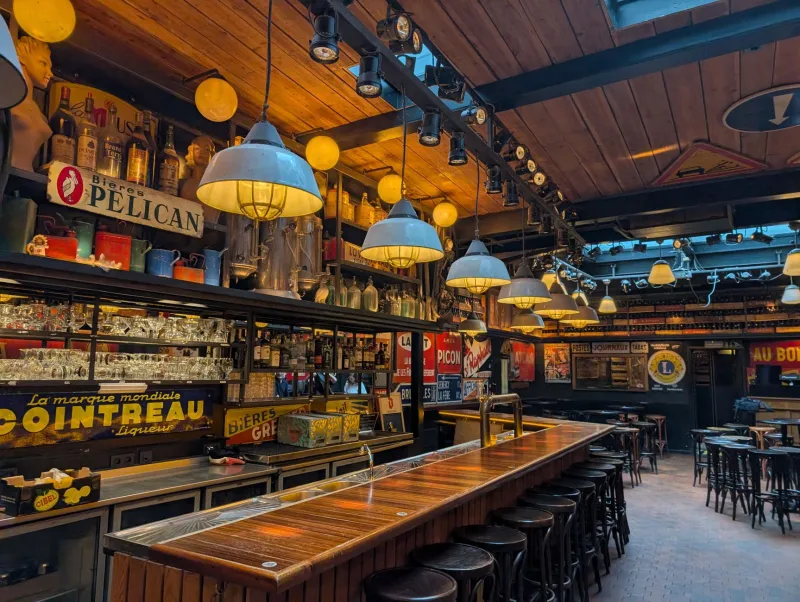
Photo: Joseph Mischyshyn, CC BY-SA 2.0, via Wikimedia Commons
At Calver's, the soundtrack is not a playlist. It's a small, ongoing negotiation between whoever is behind the bar and whoever is nearest the speakers. No one owns the aux cable. It lives behind the till, next to a biro that doesn't work and a spare pair of scissors. The result is a sound that shifts from Tuesday-evening whisper to Friday-night lift without anyone admitting they were in charge.
The First Dial-Turn Is Never About Music
Marta opens on Tuesdays. Her first job isn't barrels or the chalkboard; it's choosing the opening record. “You can't start with a banger,” she says. “People come in for a quiet pint and a read. If you put on something too big, they feel like they've walked into a party they didn't RSVP to.”
The opening playlist is built for 5pm: low tempo, familiar, nothing that demands attention. Warm soul, gentle indie, maybe a bit of Dire Straits if the day has been long. It's not about taste. It's about permission. The music tells the room it's okay to talk at normal volume.
The corner speakers are deliberately modest. Calver's isn't a gig venue. The sound is meant to sit under conversation, not over it. There's a volume ceiling agreed by staff and enforced by a strip of gaffer tape on the dial. “If the tape comes off, it's been a big night,” says bar manager Owen. “We put it back on before close.”
The Request Floor, Where Confidence Meets the Queue
Regulars request songs. Some ask politely; some treat the bar like a wedding DJ booth. Dev, a corner-bench fixture, has a Friday ritual: he asks for the same song every week at 8:15pm. “It's not a good song,” he admits. “But it's our song. The bar staff know it's coming. It's part of the furniture now.”
The staff have a rule: if the request fits the room, it goes on. If it doesn't, they say “I'll see what I can do” and then play something adjacent. It's diplomacy, not deception.
A man once requested a fourteen-minute prog-rock epic at 11:40pm. The bar was down to six people and a dog. Owen played the first forty-five seconds, faded it out, and put on Van Morrison. The man didn't notice. Another regular asked for a Christmas song in October; the bar has an unwritten no-Slade-before-December rule, but they played The Pogues because it's technically a winter song and the regular had just lost his brother. Context matters more than the calendar.
Three Songs That Have Been Quietly Banned (And One That Never Will Be)
Not banned in a formal sense. More rested. The staff won't play Wonderwall after 11pm because it invites a singalong that turns into a shoutalong. They avoid Mr Brightside on quiet Wednesdays because it makes people leave their seats and the room feels emptier when they sit back down. And they don't play football chants unless there's a match on and the pub is already loud enough to absorb it.
The one that never gets vetoed: Dancing in the Dark. It's the emergency lever. If the room is flat and the night is slipping, Owen puts it on and by the second chorus someone is tapping the table. It's not cool, but it works.
A Practical Guide to Changing the Mood Without Clearing the Room
Want to hear something different? Ask. But ask like a person, not a playlist. The best requests come with a reason: “It's my mate's birthday”, “We've just had good news”, “This was my dad's favourite”. Staff can work with a reason. They can't work with “put something good on”.
Timing matters. Between 7pm and 9pm, the room is still deciding what kind of night it is. A left-field request can land. After 10pm, the volume is up and the crowd is set; a sudden change feels like a fire alarm. If you want to shift the mood, ask for something adjacent to what's playing, not the opposite. If it's indie, ask for more indie with a different tempo. If it's soul, ask for something with a bit more brass. Don't ask for thrash metal during the quiz.
Also: don't request songs on a screen. Calver's doesn't have one. The bar staff are the screen. They are also the algorithm. Be nice to them and they'll remember your song next time.
The Last Half-Hour Has Its Own Rules
The final thirty minutes are a soft landing, not a party. The music changes at last orders. The tempo drops, the lights come up a notch, and the playlist becomes a signal: finish your pint, find your coat, say your goodbyes. “You can't play something that makes people want to stay,” says Marta. “You have to play something that makes them want to come back.” The last song is usually something warm and slightly sad. Not depressing. Just enough to make the walk home feel like part of the night.
So who really chooses the music at Calver's? Everyone and no one. The staff hold the dial, the regulars hold the requests, and the room holds the veto. It's not a perfect system. It's a neighbourhood one. And most nights, it sounds about right.